
I remember learning many ways to classify words and sounds during my middle years in public school, roughly from fourth through eighth grades. We learned about similes and metaphors. We gradually grasped the concept of onomatopoeia. Synonyms and antonyms were an easy concept, and a thesaurus has long been my most-used reference book, not because I don’t know a synonym for a word but because sometimes I can’t readily think of the one I want to use.
Another category of words is that which includes the homo- (same) and hetero- (different) groupings. These are tricky, and not all such groupings are identified by names.
A homophone pair (homo = alike, phone = sound), for instance, includes words that have the same pronunciation but different meaning. If the words in a homophone pair are spelled and pronounced the same but have different meanings then they are also called homonyms (from Greek, homo = alike, nym = name). If the words in that pair are spelled differently (but sound the same) and have different meaning then they are still homophones bit are also classified as heterographs (hetero = different, graph = appearance).
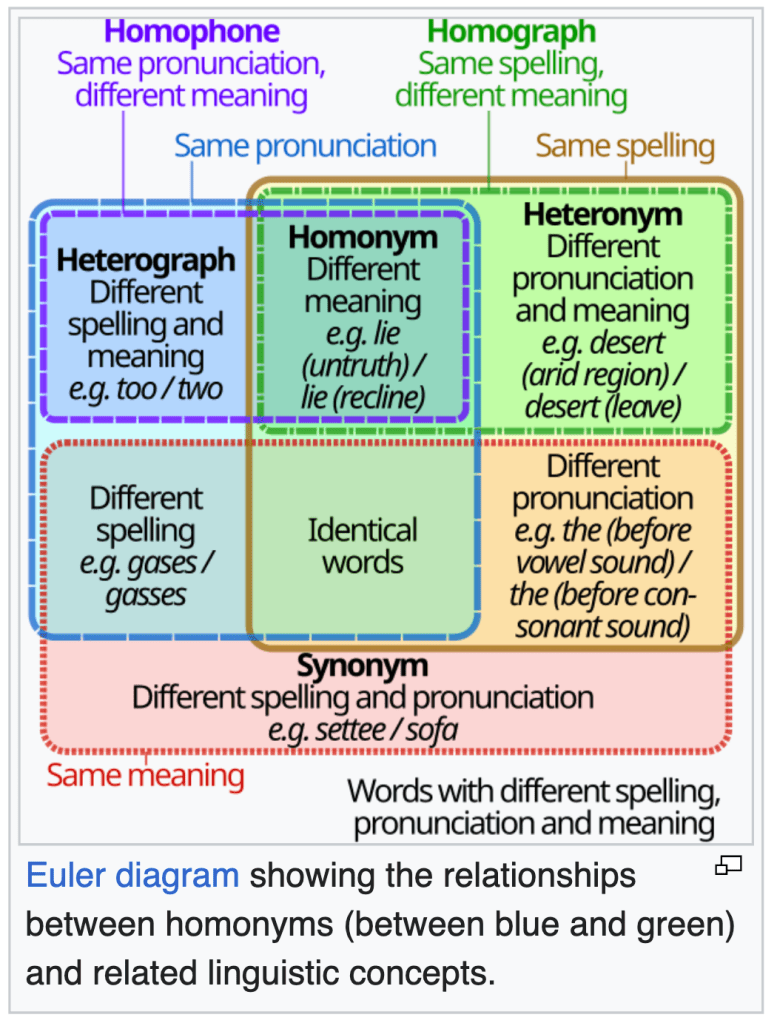
Refer to the Euler diagram to help determine what category a pair of similar words might belong to.
Heteronyms are pairs of words that are spelled the same but pronounced differently (so they are not homophones), and they also have different meanings.
In Cold Morning Shadow, high school students Cyleine and Garnette are assigned to construct a list of homophones that are also heterographs, also to collect words that have other interesting characteristics. Their results are given in Chapter 27 of the novel.
This page combines their limited list of heterographs which are homophones, with many more such pairs. The subject is highly subjective. Many words that sound alike in everyday speech may be properly pronounced a little differently, but few take care to emphasize those differences. “Mower” and “more” should not sound exactly the same, but who takes care to emphasize that “mower” is comprised of two syllables?
The lists that the two girls assemble in the novel acknowledge the subtleties of speech as well, for one of the two has a severe hearing impairment. Words carefully pronounced in her presence, especially when strung together in sentences, are still often radically misunderstood. Therefore a list of words that are homophones according to her hearing are words that most of us would exclude from our own list.
Risofins
Homophones of course are words that rhyme. Heterographs — homophones that are spelled differently — are in also in a group that I call risofins (from Latin: ri = rhyme, so = sound, fin = ending). Risofins are any two or more words in which the final syllable or syllables rhyme. While homonyms are also risofins, I took some time to construct a list of risofins in which the rhyming syllables are spelled differently.
What more can I say…?
 the novel